
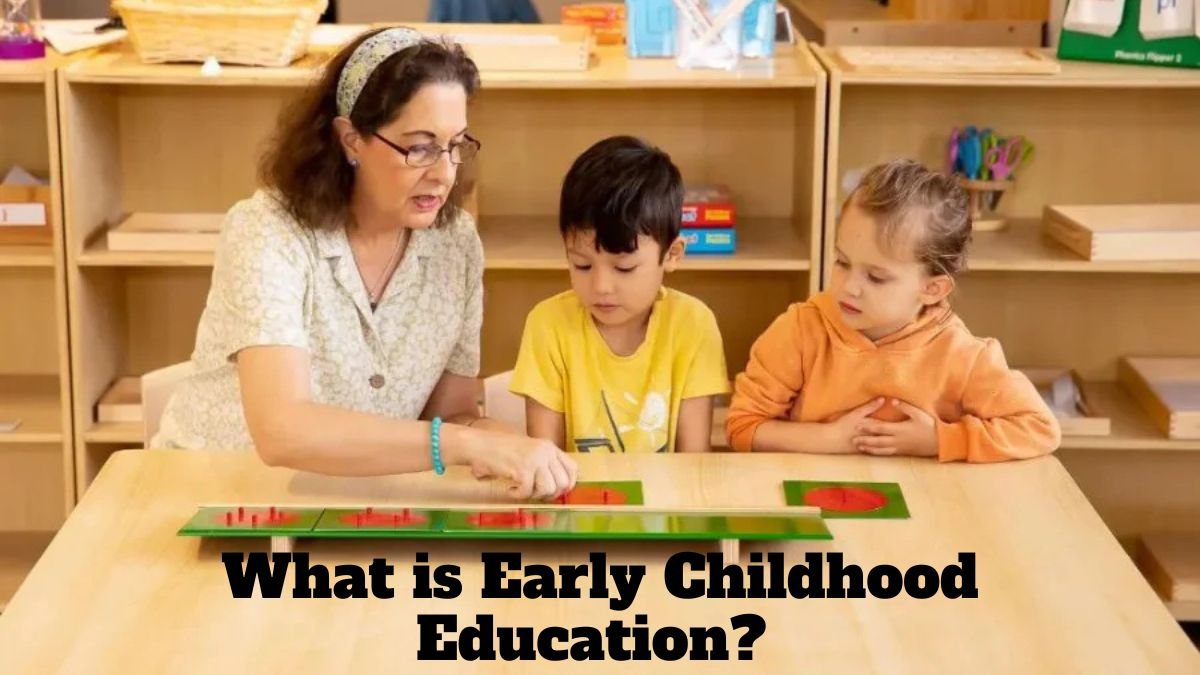
When a child is born, they are like a blank page. Their thoughts, feelings, and way of understanding the world are gradually shaped by the environment in which they grow up. The education imparted during this early stage lays the foundation for their entire life. This is called Early Childhood Education.
This education is not limited to reading and writing, but also encompasses a child’s social, mental, emotional, and physical development. In this article, we will explore in detail what Early Childhood Education is, why it is needed, and how it shapes a child’s future.
What is Early Childhood Education?
Early Childhood Education generally covers the period from birth to approximately eight years of age. During this period, a child’s brain develops most rapidly. What they learn during this time influences their future learning abilities and personality.
The purpose of this education isn’t just to teach children letters or numbers, but to give them the opportunity to think, understand, share, and express themselves.
This is the time when children learn through play—like recognizing colors, counting objects, talking to others, or expressing their feelings. These small things lay the foundation for greater learning.
The Importance of Early Childhood Education
Many parents think that school education is the real beginning, but the reality is quite different. Experts believe that the first five years of life are the most crucial.
The education provided during this period shapes a child’s mental capacity, self-confidence, and social behavior. If a child receives the right guidance, environment, and loving education at this age, they become more confident, cooperative, and creative in the future.
Early education also develops curiosity, language skills, and a sense of cooperation with others. This is why, in most countries, “Early Childhood Education” is considered an integral part of the formal education system.
Objective of Early Education
The fundamental objective of early education is to promote the child’s holistic development.
This education develops the child mentally, emotionally, physically, and socially.
The role of teachers and parents is equally important here.
Through this education, the child is prepared for the following:
Developing an interest in learning
Enhancing the ability to communicate with others
Developing self-confidence and self-reliance
Inculcating good habits and moral values
Developing problem-solving and decision-making skills
The role of early education in a child’s development
A child’s brain develops most rapidly during the first few years. The experiences they receive during this time influence their brain structure.
If a child is provided with an encouraging, safe, and loving environment during this time, their intellectual potential increases significantly.
Research shows that children who receive early education perform better later in life, stay in school longer, and play a more active role in society. However, children who do not receive the proper foundation of education at this age may lag behind in self-confidence and social skills in the future.
Key Elements of Early Childhood Education
Early childhood education does not rely solely on books. It is imparted through activities, play, communication, and experiences.
Some key elements of this education include:
- Learning through play, where children naturally understand things.
- Social interaction, through which they learn to connect with others.
- Linguistic development, so that children can express their thoughts clearly.
- Emotional understanding, so that they can understand their own and others’ feelings.
- Creativity and imagination, which help them problem-solve and develop new ideas.
Role of Teachers and Parents
The partnership between both teachers and parents is crucial in early childhood education.
Teachers provide children with a positive, safe, and creative environment, while parents provide them with the opportunity to experience and embrace that learning at home.
Parents should interact with their children, teach them new things through play, and appreciate their efforts.
Teachers should understand each child’s abilities and interests and provide education accordingly.
Status of Early Childhood Education in India
“Anganwadi Centers” and “Pre-schools” are playing a major role in this direction.
The government has also placed special emphasis on early childhood education under the National Education Policy (NEP 2020).
Formal education now begins at the age of 3, preparing them for school life.
In addition, many private institutions are also providing early childhood education through “Play School” and “Montessori” models, where children learn through play, art, and activities.
Benefits of Early Education
When children are educated at an early age, they become stronger not only intellectually but also emotionally.
Such children are self-reliant, have greater problem-solving abilities, and understand social relationships better.
In addition, this education also teaches them discipline, time management, and decision-making.
Several studies have found that children who receive early education are more likely to succeed later in life.
Conclusion – The Most Important Beginning of Life
Early childhood education is not just a subject; it is the first and most important foundation of a child’s life.
If this foundation is strengthened, the entire building block—the child’s personality, career, and life—is strengthened.
It is the responsibility of both parents and teachers to provide a child with an environment where they can learn without fear, without pressure, and with complete curiosity.
