
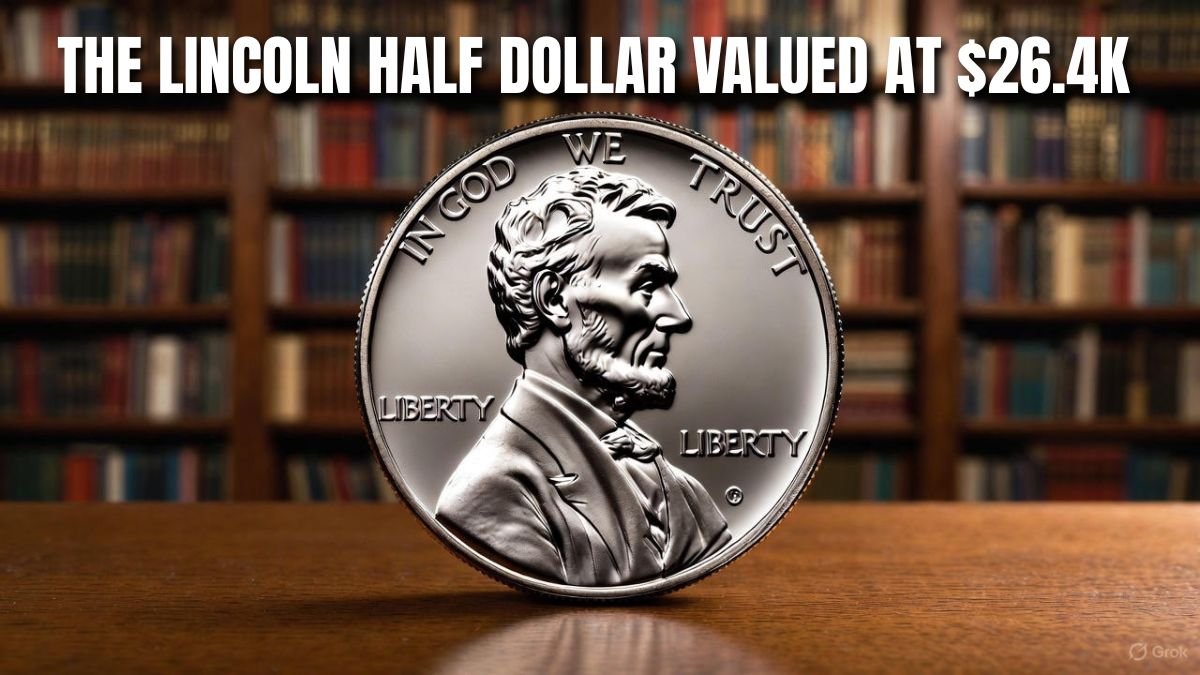
The Lincoln Half Dollar Valued at $26.4K: In the world of numismatics, the study of coins, some coins stand out, captivating collectors and history enthusiasts not only for their monetary value but also for their historical significance. One such example is the 1795 Flowing Hair Half Dollar, which recently fetched an astonishing $26,437.50 at auction. This is more than just a coin; it’s a symbol of a young nation’s artistry, ambition, and identity. Every surviving example is a tangible link to the early days of American currency, telling a story of independence, craftsmanship, and national pride.
The Genesis of American Currency
Following the American Revolutionary War, the United States relied heavily on foreign currencies, particularly the Spanish dollar, for trade. This mixed system was challenging for a nation striving to establish a unified economic identity. The Coinage Act of 1792 was poised to change this. This act established the United States Mint in Philadelphia and granted it the authority to create a national currency system.
The Flowing Hair Half Dollar, issued in 1794 and 1795, was one of the Mint’s first federal coins. Its introduction was not merely a practical necessity but also a symbolic declaration that the new republic could mint its own currency. Each coin from that era is directly connected to George Washington’s cabinet and the formative years of American governance.
1795 Flowing Hair Half Dollar Specifications
Here are some key specifications of the 1795 Flowing Hair Half Dollar:
- Year of Issue: 1795 (also 1794)
- Denomination: $0.50
- Recent Auction Price: $26,437.50 (March 2026, in excellent condition)
- Main Metal Composition: 89.24% silver, 10.76% copper
- Designer: Robert Scot, first Chief Engraver of the U.S. Mint
- Obverse Design: Lady Liberty with flowing hair
- Reverse Design: Small eagle in a wreath
- Weight: 13.48 grams
- Diameter: Approximately 32.5 mm
- Mintage: Approximately 299,680
- Key Varieties: Two leaves vs. three leaves under the eagle; Liberty’s drapery centered or off-center
- Historical Context: One of the first federal coins of the United States
Artistic and Early Design Challenges
Robert Scot, the Mint’s first Chief Engraver, attempted to represent the ideals of Liberty and freedom through a neoclassical approach. Lady Liberty’s flowing hair symbolizes unrestrained freedom, while the small eagle on the reverse represents balance and subtle power. Although the design was aesthetically pleasing, early Mint equipment failed to consistently produce high-quality coins, further contributing to the rarity of well-preserved examples.
The Flowing Hair design was short-lived and replaced in 1796 by the Draped Bust design. A more mature and serene image of Liberty was preferred by the public. This short lifespan further enhances the historical and collectible appeal of the 1795 coin.
What Makes the 1795 Half Dollar So Valuable?
The high value of the 1795 Flowing Hair Half Dollar is a result of a combination of factors. First and foremost is its historical significance—it is one of the earliest federal coins. The number of surviving coins is limited; due to centuries of use, melting, and loss, only a small fraction of the original mintage remains in collectible condition.
Collectors often focus on subtle variations, such as the number of leaves beneath the eagle or the placement of Liberty’s drapery. Certain variations can significantly increase the demand and price of a particular edition in the market. High-quality coins, especially those graded by professional services like PCGS or NGC, consistently attract vigorous bidding.
Modern Discoveries and the Collector’s Appeal
While it’s sometimes claimed in the media that such coins might still be “in circulation,” the reality is that finding a 230-year-old half dollar in everyday change is virtually impossible. Most surviving coins are safely held in private collections or institutions. Nevertheless, the romantic notion of discovering a rare coin in a forgotten box or inherited belongings continues to inspire collectors and fuels the thrill of numismatics.
Even if a Flowing Hair Half Dollar isn’t found among common coins, a careful examination of older coins can reveal other valuable silver coins, minting errors, or historically significant examples. Each small discovery becomes a tangible link to the past.
Care and Preservation of Rare Coins
If you believe you’ve found a valuable coin, careful handling is essential. Handle coins only by the edges and avoid any cleaning or polishing, as these can significantly reduce the coin’s value. Professional authentication and grading services are crucial for verifying a coin’s authenticity and condition, providing collectors and sellers with accurate valuations.
Broader Collectible Context
The 1795 Flowing Hair Half Dollar is part of a broader category of early American coins that are highly sought after by collectors. Notable examples include the 1794 Flowing Hair Dollar, the 1793 Chain Cent, and early gold coins such as the 1795 Eagle. In all these cases, rarity, historical significance, and condition are the primary factors determining value. Numismatics, the study and collection of coins, is a blend of historical research, artistic appreciation, and market awareness. For collectors, owning a Flowing Hair Half Dollar is not just about wealth; it’s about holding the story of the nation’s origins in their hands. It’s something to behold.
Conclusion
The 1795 Flowing Hair Half Dollar demonstrates that coins are far more than just currency. It embodies the art, ambition, and historical context of America’s early years. Each surviving coin provides a tangible link to the nation’s nascent aspirations, offering both collectors and historians a rare opportunity to connect directly with the past. Beyond its silver content or auction price, the true value of this coin lies in its ability to tell a story—the story of a nation finding its identity.
FAQs
Q. What is the 1795 Flowing Hair Half Dollar?
A. It is one of the earliest U.S. federal coins, minted in 1794–1795, featuring Lady Liberty with flowing hair and an eagle on the reverse.
Q. Why is it valuable?
A. Its historical significance, rarity, limited surviving numbers, and design varieties make it highly collectible.
Q. How much can it sell for?
A. Recent auctions have seen prices as high as $26,437.50 for well-preserved examples.
