
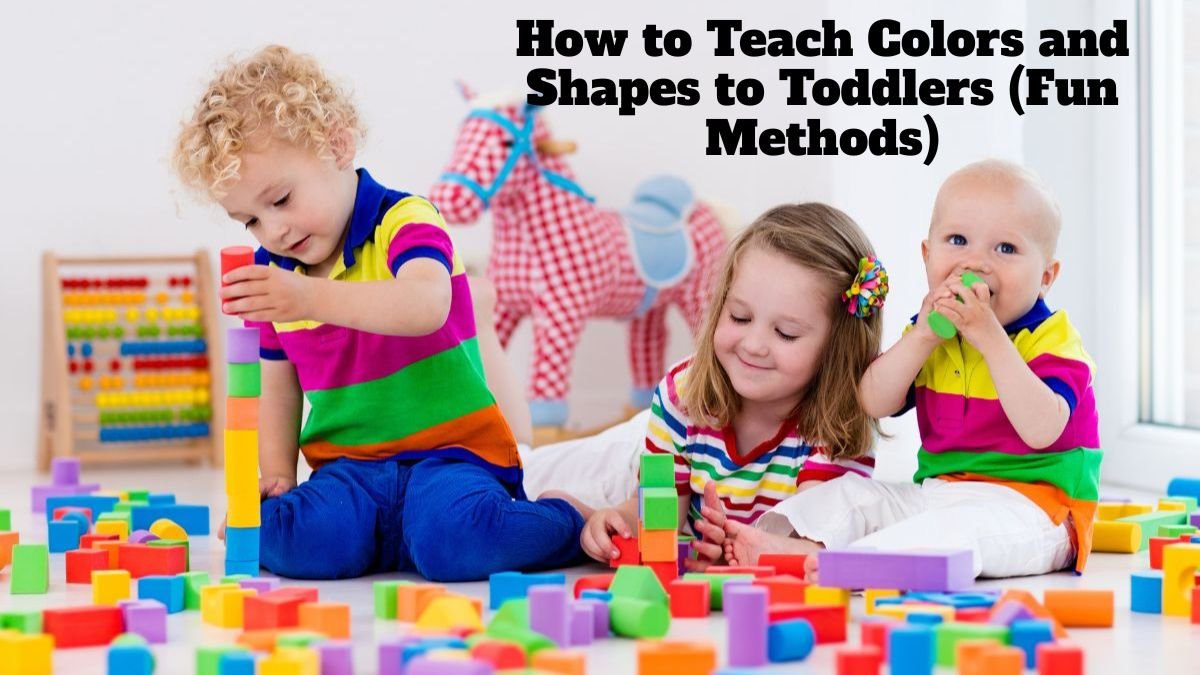
Recognizing colors and shapes is the most basic yet crucial step in a child’s early learning process. Between the ages of two and four, children begin to recognize, name, and connect with the objects around them. If taught properly at this age, their thinking and understanding abilities develop rapidly.
In this article, we’ll explore 10 easy and fun ways to teach your toddler colors and shapes—all without pressure, and through play!
Start with the things around you
Children learn colors first from their environment. So start with everyday objects in the house—like a red apple, a green leaf, a blue sky, a yellow banana. Whenever your child sees a colorful object, name it.
For example: “Look, son, this is a red apple!” or “How beautiful this green tree is!”
When a child is connected to everyday objects, their brain begins to recognize colors naturally.
Teach Color Recognition with Colorful Toys
Toddlers love toys, so why not turn them into a learning tool?
Toys like blocks, balls, or color cups can be used to play “color recognition” games.
For example, say, “Give me the red ball,” or “Now find the blue block.”
This way, the child has fun and learns the names of colors without using books.
Teach Colors Through Art and Drawing
A fun way to teach colors is through drawing or coloring books. Ask children to color, each time telling them which color they are using.
“Now paint the sky blue,” “Make the sun yellow,”—instructions like these not only help children recognize colors but also foster creativity.
These activities also improve their motor skills—hand grip—and their ability to concentrate.
Use household items to teach shapes
You don’t need any expensive teaching tools. Shapes can be taught using household items.
For example, a plate is a circle, a book is a rectangle, a pillow is a square, and a triangular loaf of bread is a triangle.
When you point them out and say, “Look, this is a round plate,” your child learns through both sight and hearing.
Puzzle Games and Shape Sorter Toys
Many types of “shape sorter toys” or “puzzle games” are available on the market these days.
These games help your child understand which object fits into which shape.
When your child tries to figure out how to “get the triangle piece into the hole in the triangle,” they begin to better understand the identification of shapes.
These small games also strengthen their problem-solving skills in the future.
Teach through songs and poems
Children remember songs quickly. Learning will be easier if you teach colors and shapes in the form of rhymes or songs.
For example:
“Red, yellow, blue, and green,
These are bright and clean colors.”
Or in Hindi—
“Red apple, yellow sun, lovely blue sky,
The world is full of colors, look what a beautiful view.”
Learning through songs keeps children excited and strengthens their memory.
Explain colors and shapes through nature
Go for a walk every day and show your child trees, flowers, clouds, and birds.
Ask them, “What color is this flower?” or “What shape is this leaf?”
Exploring the colors and shapes in nature fosters curiosity and encourages them to view learning as “fun,” not “study.”
This approach is beneficial for both their mental and emotional development.
Incorporate colors and shapes into storytelling
Whenever you tell a story to your child, incorporate colors and shapes.
For example, “One day a red ball flew across the blue sky…” or “There was a round sun and a square house…”
This allows the child to identify colors and shapes through imagination.
Stories profoundly develop children’s memory, language, and visual understanding.
Make the Home a Learning Zone
Make certain areas of your home a learning zone.
Put color charts on the wall, put shape stickers on the refrigerator, or create a “color wall” on the door.
When a child sees these things repeatedly, their memory is strengthened, and learning becomes natural without any pressure.
If a child is surrounded by colors at home, they will begin to recognize them on their own.
Praise and Replicate for Every Achievement
Two things are most important in the learning process—praise and repetition.
When your child gives the correct answer, immediately praise them: “Wow! You got it right!”
This boosts their confidence.
And repeat things they don’t remember in fun ways.
Because every repetition becomes a “fun learning challenge” for the child.
Conclusion: Make learning fun, not forced
Teaching colors and shapes to toddlers doesn’t have to be a difficult task; just make it a “play” instead of “studying.”
When the learning environment is filled with love, play, and laughter, the child will develop a desire to learn.
Remember—every child learns at their own pace, so give them time and encouragement instead of comparison or pressure.
A little patience and creativity can fill your child’s world with “colors and shapes.”
