
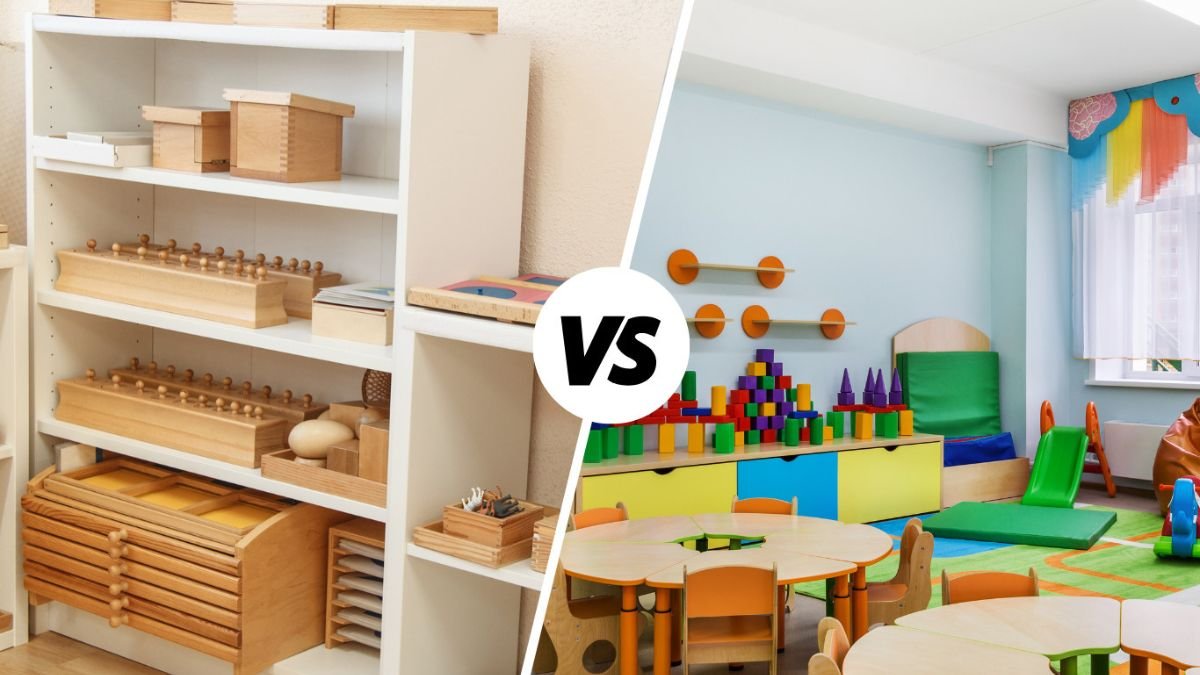
Montessori vs Traditional Preschool: Every parent wonders which school is best for their child’s early education—Montessori or traditional preschool. Both education systems are designed to promote child development, but their methods and approaches differ. The truth is, neither system is “better” or “inferior”; it really depends on the type of environment your child learns best in and your family’s educational priorities.
The Montessori Method of Education: A World of Self-Reliance and Discovery
The Montessori system is founded on the idea that every child naturally desires to learn. The focus of education is the child, not the teacher. In this system, children are given the freedom to learn at their own pace and gain knowledge from their own experiences.
Generally, Montessori classrooms are characterized as being calm, well-arranged, and exhibiting a delicate kind of atmosphere. These classes aim to nurture the children’s natural need to learn through their tactile, sensory, and practical experiences. The setting is split into various segments—practical life, sensorial development, math, language, and cultural studies.
Kids are not limited by a specific time or curriculum. Any child can, according to his/her interest and capability, take part in a certain task and finish it at his/her own speed. Montessori education through this way builds the qualities of self-confidence, self-discipline, and independent thinking in children.
The Role of the Teacher in Montessori: A Guide, Not a “Teacher”
Apart from the traditional concept of “teaching,” the teacher’s role in the Montessori method is rather to “guide.” They closely observe the children, figure out which subject or activity each child is most interested in, and then provide assistance on a very personal basis.
Teachers do not provide children with most of the information they need but instead become facilitators who open the doors to children’s curiosity. This is the reason why the Montessori system is considered the most suitable one for kids who are independently inclined, are attracted by the idea of doing a hands-on activity, and are internally motivated.
Traditional Preschool: An Environment of Discipline and Structure
On the other hand, the traditional preschool system follows a more structured education system. Here, the teacher is at the center of the classroom, overseeing the entire curriculum.
Traditional classrooms are typically colorful, engaging, and full of energy. It involves group activities, songs, games, and other collaborative learning methods. This environment allows children to experience teamwork, discipline, and social interaction.
The traditional system’s teaching approach is relatively structured. Each day has a set schedule, with designated periods for academic activities, play, and relaxation. This routine teaches children time management and discipline.
The Teacher’s Role in Traditional Schools: Leadership and Guidance
The teacher’s role in traditional preschool is both a guide and a coach. They set the pace of the class, teach children collectively, and motivate them to achieve specific goals.
The purpose of this system is to prepare children for the next level of education, i.e., primary education. Therefore, activities like counting, letter recognition, drawing, storytelling, and memory-enhancing are included.
Traditional schools are considered better for children who enjoy working in groups, learn from external motivation, and perform better with clear instructions.
Which System to Choose: What Should Be the Basis for the Decision?
When parents decide which system is right for their child, they should consider a few important things.
First, it’s crucial to understand your child’s personality traits. Is your child naturally independent and inquisitive? Does he or she prefer to play or learn alone? If so, Montessori may be an excellent choice. But if your child prefers to be with others, needs direction or instruction, and enjoys group activities, a traditional preschool may be more suitable.
Second, consider your goals for your child. Do you want him or her to achieve academic success from an early age? Or do you want him or her to become independent and confident first?
When choosing a school, rely on experience, not just hearsay.
Don’t just trust the internet or the recommendations when deciding which school to attend. Go and see the two schools for yourself. Watch how the teachers speak to the children, how the positive the environment is, and how the children react.
Maybe a program that seems great just from reading the paper won’t suit your child’s nature. So, getting to know the surroundings personally is essential. A school where a child is safe, is inquisitive, and takes pleasure in learning is the right one.
Conclusion: There’s No One Way for Every Child
In the final analysis, neither Montessori nor traditional preschool can be considered the universal “best” option of any child. Each child is an individual—their curiosity, temperament, learning pace, and interests vary. Hence, the educational choice should be correspondingly personalized.
If you decide according to your child’s tendencies, emotional needs, and family values, you will be absolutely sure that they are going to an environment where they can prosper, learn, and become self-assured. The truth is, the goal of education is not only to gather knowledge, but to create a well-rounded personality—and this is the primary aim of both systems.
