
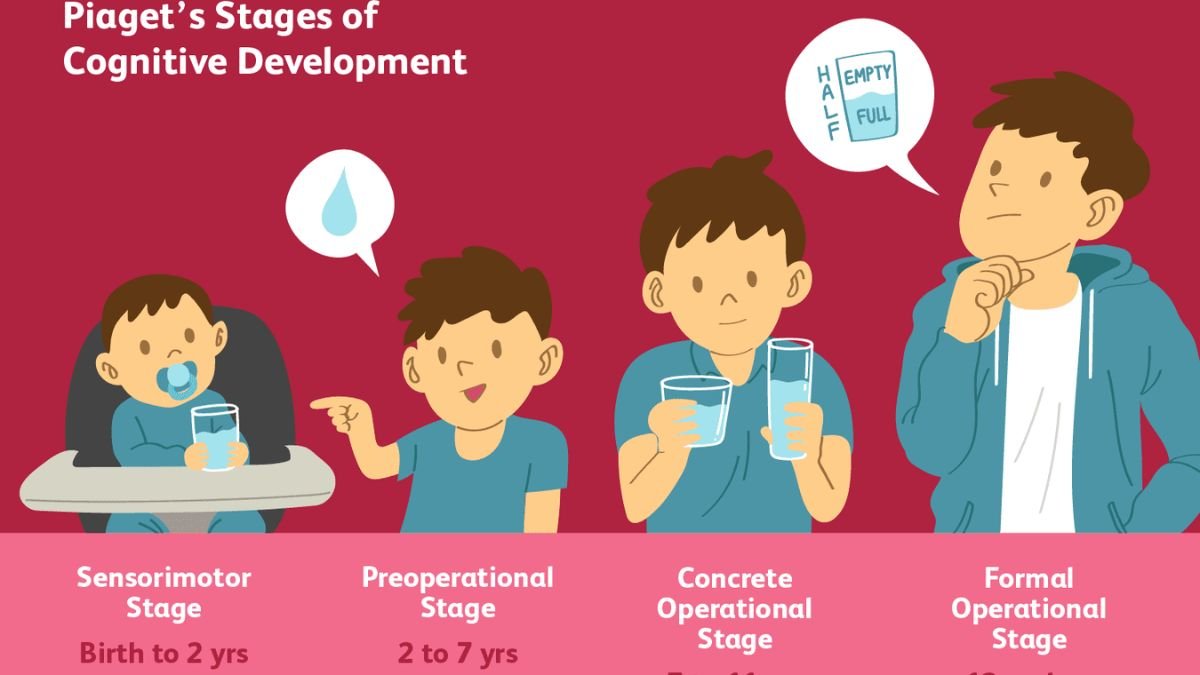
Every child is born with a unique ability to think and understand. However, this ability doesn’t come suddenly; it develops gradually with time and experience. This entire process is called cognitive development.
It’s the journey through which a child develops their ability to think, understand, learn, and make decisions. Let’s explore the 10 key stages of brain development in children’s early years—which lay the foundation for their future.
Birth to 2 Years – Sensorimotor Stage
This stage is the most crucial part of life. During this time, children begin to understand the world around them through touch, taste, smell, sound, and sight.
They repeatedly touch objects, put them in their mouths, and drop them to see what happens. This is how their brains learn about “cause and effect.” For example, if a toy falls, a sound is produced—meaning a cause is linked to an effect.
2 to 4 Years – Language and Symbolic Thinking Stage
At this age, children begin speaking and associating words with meaning. They begin to use toys, dolls, or objects as if they were real.
For example, they may play with a wooden stick as a sword or call a toy “mom” and talk to it. This is an early sign of imaginative thinking.
4 to 6 Years – Egocentric Thinking
In this stage, children view the world from their own perspective. They believe that everyone thinks or feels the same way they do.
For example, if they are cold, they assume everyone else must be feeling the same. This thinking gradually changes as they begin to understand the feelings of others.
6 to 7 Years – Beginning of Logical Thought
Children now begin to understand the patterns and rules around them. They become familiar with basic mathematical concepts like counting, addition, and subtraction.
They also begin to understand that things can remain the same in quantity despite changing shape—for example, pouring water from one glass to another doesn’t change volume. This understanding is called the “Conservation Concept.”
7 to 9 Years – Concrete Operational Stage
Children’s thinking becomes more realistic. They move beyond imagination and draw conclusions based on objects and events.
They begin to understand relationships between things—such as “If it’s heavy, it will go down.”
This stage helps them solve real-life problems, such as math problems or game rules.
9 to 10 Years – Social Understanding and Teamwork (Social Understanding Stage)
Children now understand that living in society is a collective process. They learn to work in teams, share, and follow rules.
At this age, activities like school, sports, and friends strengthen their social minds. They now think in terms of “we,” not just “I.”
10 to 11 Years – Moral Reasoning
At this stage, children begin to understand the difference between right and wrong. They understand why rules are important and the consequences of violating them.
Their thinking now moves beyond “Mom told me not to” to “This is not right, so I shouldn’t do it.” This is the seed of morality that shapes a person’s character in the future.
11 to 12 Years – The Beginning of Abstract Thinking
Children’s minds begin to ask questions like “What if this happens?” They begin to think imaginatively—that is, they can consider even what is not visible.
For example, “What would happen if the Earth stopped rotating?” Such questions reflect their curiosity and become the foundation for creativity.
From 12 onwards – The Rise of Decision-Making and Reasoning Power
Children now develop decision-making abilities. They can evaluate pros and cons, defend their opinions, and provide logical answers.
At this stage, their self-confidence also grows, and they begin to learn from their experiences and make future plans.
Emotional Intelligence and Self-Awareness
The final, but crucial, part of cognitive development is understanding and controlling emotions.
Children learn how to express anger or sadness, how to read others’ emotional signals, and how to empathize.
This emotional understanding later becomes the foundation for their relationships, studies, and success in life.
Conclusion: Steps to Thinking, the Path to Success
Cognitive development is a lifelong journey. The stronger the foundation laid in childhood, the more balanced a child’s mental, social, and emotional development will be.
The support, love, and proper guidance of parents and teachers accelerate this development. Every question, every curiosity, every game—it shapes a child’s mind.
