
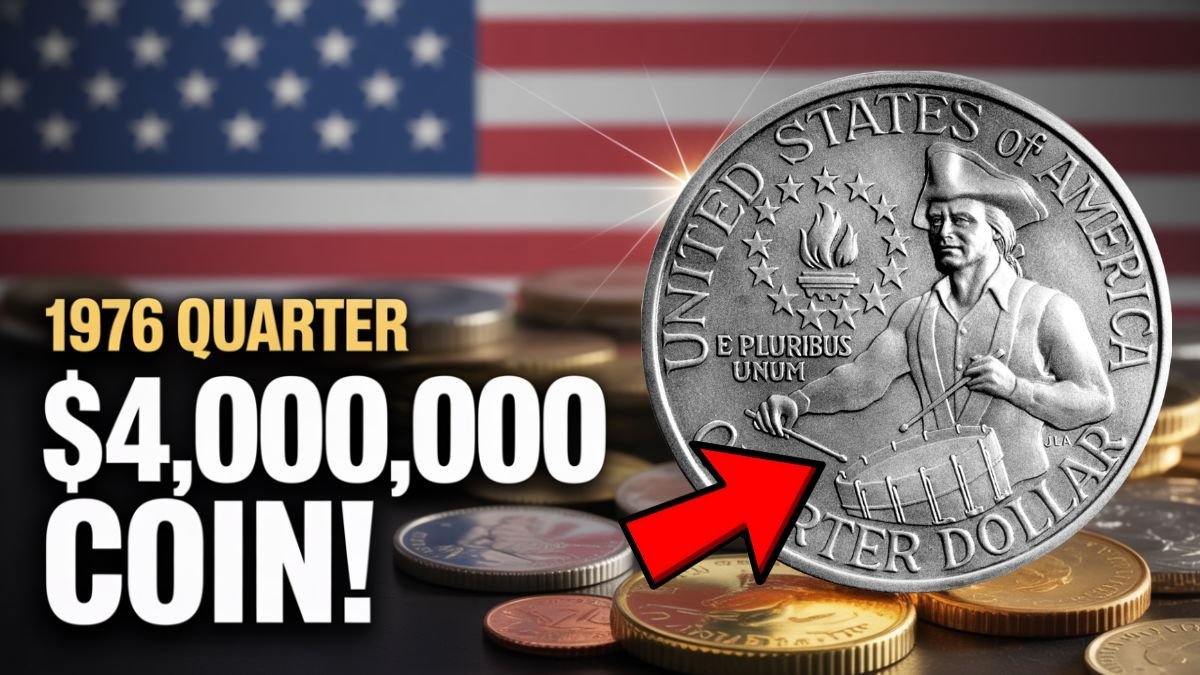
In the world of rare coin collecting, few stories capture attention quite like the claim that a 1976 Bicentennial Quarter could be worth as much as $4 million. To many people, this sounds unbelievable. After all, the Bicentennial Quarter is a familiar coin that millions of Americans have seen, spent, or even saved in drawers and jars. Yet, within this seemingly ordinary coin lies the potential for extraordinary value—if certain rare characteristics are present.
This article explores why some 1976 Bicentennial Quarters are considered priceless, what makes one version potentially worth millions, and how collectors and everyday people alike can identify whether they are holding a historic treasure or a common keepsake.
The Historical Significance of the 1976 Bicentennial Quarter
The Bicentennial Quarter was issued to commemorate the 200th anniversary of American independence. Instead of the traditional eagle design on the reverse, the coin features a colonial drummer boy, symbolizing the spirit of the American Revolution. The obverse still displays George Washington, but with the dual date 1776–1976, making it immediately recognizable.
The U.S. Mint produced Bicentennial quarters in enormous quantities to ensure nationwide circulation. These coins were minted at three facilities: Philadelphia, Denver, and San Francisco. While most of these quarters are worth only face value or slightly more, a very small number were struck under special conditions that make them extremely rare and valuable today.
Why Some Bicentennial Quarters Are Worth Millions
The idea of a $4 million Bicentennial Quarter is tied to rarity, condition, and unique minting errors. Coin values increase dramatically when supply is extremely limited and demand among collectors is intense. In this case, only a handful of quarters are believed to possess the precise combination of features that push their value into the millions.
These rare coins are often associated with experimental strikes, transitional errors, or special metal compositions that were never intended for circulation. When such a coin surfaces, it becomes the centerpiece of elite numismatic auctions, where wealthy collectors compete for ownership.
The Importance of Metal Composition
One of the most critical factors in identifying a potentially priceless Bicentennial Quarter is its metal content. Most quarters minted for circulation in 1976 were made of a copper-nickel clad composition. However, the U.S. Mint also produced 40% silver Bicentennial quarters, primarily intended for collectors and sold in special sets.
While silver Bicentennial quarters are more valuable than standard ones, they typically do not reach anywhere near $4 million. The coins rumored to be worth millions are believed to be struck on experimental or incorrect planchets, possibly using metals never officially authorized for quarters. If a quarter weighs more or less than expected or shows unusual coloration, it may warrant professional evaluation.
Rare Mint Errors That Drive Extreme Value
Mint errors are among the most sought-after features in coin collecting. For the 1976 Bicentennial Quarter, errors such as double die strikes, off-metal strikes, and misaligned designs can significantly increase value.
A double die error occurs when the coin design is imprinted twice, creating noticeable doubling in the lettering or images. Off-metal strikes happen when a coin is accidentally struck on a blank meant for another denomination or foreign coin. These errors are rare by nature, but when combined with the historic Bicentennial design, their value can skyrocket.
The quarter rumored to be worth $4 million is believed to feature an exceptionally rare error, possibly combined with an unusual metal composition and pristine condition.
Condition and Grading Matter More Than You Think
Even if a Bicentennial Quarter has a rare feature, its condition plays a crucial role in determining value. Coins are graded on a scale that assesses wear, luster, strike quality, and overall appearance.
A coin preserved in mint state, showing no signs of circulation, is far more valuable than one that has been heavily used. The most valuable examples are often graded at the highest levels by professional grading services. A rare quarter with flawless surfaces and sharp details can be worth exponentially more than the same coin with minor imperfections.
The Role of the Mint Mark
The mint mark on a Bicentennial Quarter can provide important clues. Coins minted in Philadelphia typically have no mint mark, Denver coins display a “D,” and San Francisco coins show an “S.”
San Francisco mint quarters are particularly interesting because that facility produced many proof and silver versions. Some of the rarest Bicentennial quarters are believed to originate from experimental runs or special proof strikes from San Francisco. While not every “S” mint quarter is valuable, it is often a starting point for identifying potentially rare examples.
How to Examine Your Bicentennial Quarter at Home
If you suspect you might have a valuable 1976 Bicentennial Quarter, careful examination is the first step. Start by checking the date and confirming the dual “1776–1976” inscription. Then examine the mint mark and overall appearance.
Pay close attention to the coin’s weight, color, and thickness. Any deviation from standard quarters could indicate an unusual planchet. Look closely at the lettering and images for signs of doubling or misalignment. Even subtle irregularities can be significant to trained collectors.
However, avoid cleaning the coin, as this can drastically reduce its value. Preservation is key when dealing with potentially rare coins.
Why Professional Authentication Is Essential
No matter how promising a coin looks, professional authentication is essential before assuming it has significant value. Reputable grading services use advanced tools to analyze metal composition, strike characteristics, and authenticity.
These experts can confirm whether a coin is genuinely rare or simply an interesting but common variant. A certified grading report not only establishes authenticity but also provides credibility if the coin is ever offered for sale or auction.
The Market for Ultra-Rare Coins
The numismatic market is driven by collectors who value history, rarity, and uniqueness. Coins rumored to be worth millions typically attract attention from elite collectors, museums, and investors.
When such a coin appears at auction, it often generates global interest. Competitive bidding can drive prices far beyond initial estimates, especially when the coin has a compelling backstory tied to American history, such as the Bicentennial celebration.
Separating Myth from Reality
It is important to approach claims of million-dollar coins with a balanced perspective. While it is true that certain Bicentennial Quarters may be extraordinarily valuable, the vast majority are worth only face value or a modest premium.
Stories of $4 million quarters often stem from extremely rare, verified examples. This does not mean every Bicentennial Quarter is a hidden fortune, but it does mean that rare treasures can exist in unexpected places.
Why the Bicentennial Quarter Continues to Fascinate Collectors
The Bicentennial Quarter represents more than just currency; it is a symbol of national pride and historical celebration. Its unique design and limited-time production make it a favorite among collectors of all experience levels.
The possibility that one version could be worth millions only adds to its mystique. This blend of accessibility and rarity is what keeps collectors searching through old collections, rolls of coins, and inherited keepsakes.
Final Thoughts on Identifying a $4 Million Quarter
The idea that a 1976 Bicentennial Quarter could be worth $4 million is both thrilling and educational. While such coins are incredibly rare, understanding what makes them valuable empowers collectors and everyday individuals to recognize potential treasures.
By examining metal composition, mint errors, condition, and provenance, and by seeking professional authentication, you can determine whether your coin is ordinary or extraordinary. Even if your quarter turns out to be common, the journey of discovery offers a deeper appreciation for American history and the fascinating world of numismatics.
In rare cases, a simple quarter can become a life-changing find. And that possibility is exactly what keeps the legend of the $4 million Bicentennial Quarter alive.
FAQs
Q1. Is every 1976 Bicentennial Quarter worth $4 million?
No, only extremely rare versions with unique errors or special metal compositions have such high value.
Q2. How can I tell if my Bicentennial Quarter is valuable?
Check the mint mark, condition, metal type, and look for rare minting errors, then get it professionally graded.
Q3. Should I clean my 1976 Bicentennial Quarter before appraisal?
No, cleaning can reduce the coin’s value and should always be avoided.
